Three Sources
The Three Laws of Every Perfect Moment, Part Two

This is Part Two of a three-part series called The Three Laws of Every Perfect Moment. The short version: every moment is either a perfect opportunity, a perfect experience, or a perfect lesson. Not good, not bad. Just perfect.
If you read Part One, you already know about the Zippo.
The universe offers you something three times. Refuse it three times and it stops asking politely and throws it at your forehead. The impact isn’t punishment. It’s the moment you finally stop having a choice about the thing you were pretending wasn’t a choice.
But here’s the question Part One didn’t answer.
What if you could catch it before the throw?
The Pattern Fires Before the Impact
There’s a skill I developed the hard way, the way most useful skills get developed: through enough forehead shots that I finally started paying attention to what came before them.
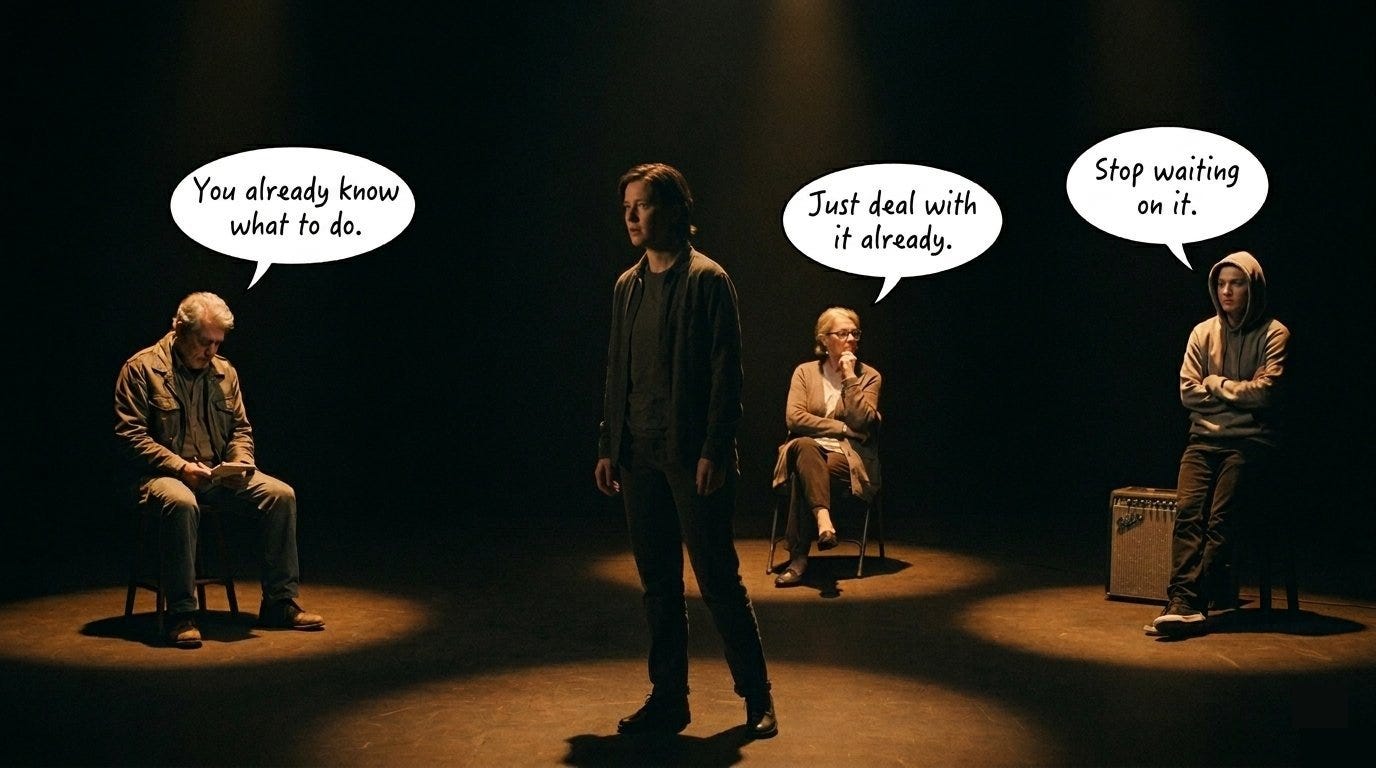
The skill is this: when the same concept arrives from three genuinely unrelated, random sources, presenting itself in distinctly different ways, that is not coincidence.
That is signal.
One is an event. Two is a coincidence. Three is a verdict.
Same rule as the Zippo. Earlier in the sequence.
The difference is that Three Sources gives you a window. A gap between the verdict and the impact. A moment where you can still choose to move before the universe removes the choice for you. The Zippo Theory describes what happens when you miss the window. Three Sources is the window.
Most people don’t know the window exists. They find out about it the same way they find out about most things: afterward, sitting in the wreckage, doing the math.
The Cold Air and the Old Man
I’ll tell you about the night the lights came on.
I won’t tell you the specifics of the situation because they don’t matter. What matters is that I was trying to avoid something with everything I had. I was running a world-class avoidance operation. I had convinced myself I was managing the situation. I was not managing anything. I was just postponing the inevitable with a lot of noise and energy I didn’t have to spare.
I don’t remember the first offer. That’s the thing about the first one: you don’t recognize it as an offer. It just looks like a passing comment, a random conversation, a thing someone said that you filed under irrelevant and moved on.
The second offer I remember clearly because it cost me something.
A friend, fed up with listening to me cycle through the same complaints about the same situation for what was apparently one time too many, put down their fork, looked at me across the dinner table, and delivered the verdict with the patience of someone who had completely run out of patience: either do something about it or repeat it.
Then they left.
I paid the check alone.
I walked outside into the cold air, doing the thing you do when you need a minute: just standing there, gathering yourself, pretending to be fine. And an old man I had never seen before walked past me on the sidewalk and said, without stopping, without any context, without any reason: “it gets easier when you just do what needs to get done, no matter how difficult it is.”
And then he was gone.
I stood there in the cold and felt something click.
I remembered the first offer I had ignored. I looked at the restaurant door my friend had walked out of. I heard the old man’s words echoing the same verdict in a different voice. Three sources. Three delivery mechanisms. One message.
I saw it. Clearly. Completely. In real time.
And I still didn’t move.
Three days later the Zippo hit. The decision got made for me. I no longer had a choice about the thing I had been pretending wasn’t a choice.
That’s the part nobody talks about. Seeing the pattern doesn’t guarantee you act on it. But we’ll come back to that.
How the Skill Actually Works
The Three Sources pattern has a few rules worth knowing.
The sources are usually unrelated. Sitting around a table with three friends telling you the same thing is not Three Sources. That’s an intervention. Three friends sitting at that table, your mechanic, and a line in a book you picked up randomly: that’s closer. The more unrelated the sources, the cleaner the signal. The universe doesn’t care about the delivery mechanism. It’ll use whatever’s available. A dinner conversation, a stranger on the street, a podcast you put on because you couldn’t sleep, a sentence in a book you weren’t even looking for.
The concept has to be the same, not the words. The three sources rarely say the identical thing. They say the same thing in completely different language. Your friend says either do something about it or repeat it. A stranger says do what needs to get done. A book says something about the cost of inaction. Different words. Same verdict. Your job is to hear through the delivery mechanism to the message underneath.
The timing doesn’t follow a schedule. Sometimes all three arrive in same day, or even week. Sometimes the first lands in January and the third lands in October and you have to remember enough to connect them. This is why the skill requires more than passive observation. You have to be paying attention across time, not just in the moment.
You don’t get to decide when you’re ready. Honestly, you rarely ever are. The pattern fires when it fires. The universe is not interested in your calendar.
Antennas and Everyone Else
Some people develop this naturally. They’re wired to receive signal. They hear the first offer and something in them goes quiet and pays attention. They catch the second and start taking notes. By the time the third arrives they’re already moving.
These are the people who seem to navigate chaos more gracefully than the rest of us. It’s not luck. It’s reception. They built the antenna, or they were born with one, and they learned to trust what it picks up.
Most people are not wired this way by default. Most people need the forehead shot first. The Zippo is the tuition. After enough impacts, you start developing pattern recognition out of sheer self-preservation. You get tired of the bruises. You start watching for the throw.
This is not a character flaw. It’s just where most people start. I’ve never seen a class taught on this. The signals are unique to you and the specific situation. No one is living your life or experience. The question is whether you ignore it and stay or cut bait.
The skill is learnable. But it requires something most people are reluctant to give it: the willingness to take the signal seriously before you have proof it’s real.
That’s the hard part. The three sources feel like coincidence until suddenly they don’t. The gap between coincidence and verdict is where most people dismiss the pattern and go back to whatever they were doing. Asking for more evidence. Waiting for certainty. Running out the clock.
The universe is not in the business of providing certainty in advance. It provides signal. What you do with the signal is your problem.
The Part Nobody Puts in the Manual
Here’s the honest version.
Even after all the years of knowing this, even after developing the skill through enough reps that the pattern recognition is practically automatic, there are still things I see the signal on and don’t move. I hear the first offer. I note the second. The third arrives and I think: yep. There it is. And I still don’t act.
Not because the system is broken. Because I’m the variable.
There’s a short list of things where the cost of change still feels higher than the cost of the Zippo. Where I know exactly what the verdict is and I’m not ready to execute it. Where I’m choosing, consciously, to stay in the pattern a little longer.
The difference between not knowing and knowing is that I can no longer claim ignorance. I see the signal. I own the choice. Whatever comes next is on me.
That’s not inspiring. It’s just true.
Pattern recognition doesn’t cure stubbornness. It just makes you conscious of your own stubbornness in real time. Which is its own particular kind of useful, and also its own particular kind of uncomfortable.
The Other Side of the Coin
Here’s the thing about the old man on the sidewalk that took me years to fully absorb.
He had no idea.
He wasn’t dispatched. He wasn’t chosen. He wasn’t delivering a cosmic telegram on behalf of the universe with full knowledge of his role in the sequence. He was just a man walking past a restaurant on a cold night saying the true thing out loud because it was true. No agenda. No judgment. No awareness whatsoever that the words he was about to speak were the third in a series that would eventually crack something open in a stranger standing in the cold air.
He walked away and forgot about it before he reached the corner. I guarantee it.
And here’s where it gets uncomfortable: you are that old man right now, for someone you may or may not know.
The thing you said to a friend two years ago that you don’t even remember saying. The offhand comment in a parking lot. The text you almost didn’t send because you figured they probably already knew. Somewhere out there, someone filed it. Someone carried it. Someone built something on the foundation of words you spoke and immediately forgot.
I know this because I’ve been on the receiving end of it. Friends have come back to me, sometimes years later, and said: remember when you told me that thing about... And I remember the conversation. I remember the before and the after. But that specific moment, the sentence they built their decision on, the words that apparently changed something for them: gone. A black hole in my memory where something important apparently happened.
The transmission doesn’t require your awareness. It just requires your honesty. Say the true thing without agenda and trust the universe to route it where it needs to go. You don’t get to know where it lands. That’s not your department.
That’s a whole other post. But it starts here, with the old man who never knew.
What You’re Actually Building
The Three Sources skill is not about becoming psychic. It’s not about finding meaning in everything or turning random life events into a vision board.
It’s about developing a filter. A way of sorting signal from noise at scale. Because the noise is constant. The signal is rare. And the signal is what matters.
The universe is always talking. Most of it is weather. The Three Sources pattern is how you know when it’s saying something specific, to you, about this, right now.
The old man wasn’t mysterious. He was just Tuesday. He happened to be the third voice carrying the same message at the exact moment I was standing in the cold air raw enough to hear it. A week earlier I would have smiled and walked to my car. That night it landed.
Readiness matters. So does repetition. You don’t build the antenna in a day. You build it across years of paying attention to what arrives and having the honesty to admit when three unrelated things are saying the same thing.
One is an event. Two is a coincidence. Three is a verdict.
The verdict doesn’t always come with a Zippo. Sometimes it comes with a window.
The only question is whether you’ll climb through it.
Part Three: Cut It the Fuck Loose. The meaningful cut is never the symptom. It’s the belief structure underneath it. And yes, there’s a lighter involved.
